Survey
of the day

Siphoners have their say!

Autoren

Cengiz Kulaksiz

I started working in the HKLS industry in 1997 and have been discussing correct drainage with customers on a daily basis since 2008, so I would like to share my experiences with you at this point. At the same time, as a long-standing member of the Austrian Standards Committee, I keep myself informed about future challenges in building drainage.
Newsletter

Yes, I want to become a siphon technician

I hereby subscribe to the free newsletter to be informed about new articles and to receive further benefits.

Air conditioning device dripping? This is the most common cause

An air conditioner dripping can indicate several problems, but double siphoning tops the list. Discover how incorrect installation of the condensate hose leads to water damage and what measures you can take to fix this problem.

There are different types of air conditioning systems, which function differently. While central building air conditioning or ventilation systems are used for large, public buildings, split air conditioning systems are becoming increasingly popular in smaller offices or private households.

Air conditioning device dripping? This is the most common cause

Air conditioning device dripping? This is the most common cause

Air conditioning device dripping? This is the most common cause

How do split air conditioning systems work?

Split air conditioning systems are divided into an outdoor unit and an indoor unit (often also referred to as an “air conditioning device”). Cooling liquid is cooled in the outdoor unit and transported to the indoor unit via cooling circuits. There, the warm air is cooled via a cooling coil – through which the coolant flows – and blown into the respective rooms via fans. In contrast to commercial and industrial air conditioning and ventilation systems, in split air conditioning systems the cold air is not transported via ventilation shafts, but the room air is cooled inside the indoor unit.

Why and how must an air conditioning unit be drained?

Condensation forms when warm air cools down. As the air in split appliances is cooled directly in the air conditioner, condensation also forms in the appliance and must therefore be drained decentrally. The condensate that forms on the cooling coil drips into a drip tray and is directed horizontally to a side outlet. There, the condensate must be directed via a hose or pipe from where it runs into a condensate siphon. The condensate siphon prevents sewer gases or bad odors from rising from the sewer into the appliance. The best solution for draining air conditioning units is the HL138 concealed condensate siphon. It is easy to maintain, simple to plan and install and the integrated ball in the siphon cassette keeps bad odors safely out of the living space.

What causes my air conditioning system to drip?

There are various reasons why an air conditioning system drips. Sometimes it is due to defective hose seals, a leaky connection or a blockage in the condensate hose. However, the most common cause of a dripping air conditioning system is double siphoning.

What is double siphoning?

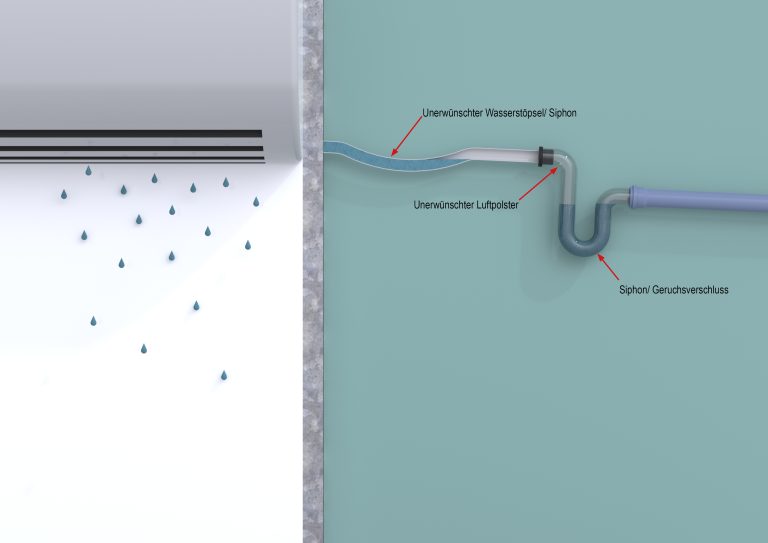
Double siphoning is caused by incorrect installation of the condensate hose. If flexible hoses are used to drain the condensate, it can happen that they start to hang and there is no continuous slope between the condensate appliance and the condensate siphon (see illustration). A water pocket forms in the hanging hose. The air cannot escape via this unwanted water sack – which behaves like a siphon/odor trap.

Air is therefore trapped between the first (unwanted) siphon and the second deliberately installed condensate siphon (hence “airlock”). To overcome this resistance, the water level rises to the height at which the back pressure of the water pushes the air cushion through the appliance siphon and the wastewater can then drain off naturally. In most cases, however, the necessary height between the air conditioning unit and the “unwanted” siphon is not given and the condensation water overflows into the drip tray of the split unit – often causing considerable water damage.

What causes my air conditioning system to drip?

An unwanted trap in the condensate hose in combination with the condensate trap results in “double siphoning” and the water leaks out of the indoor unit

How do I avoid double siphoning?

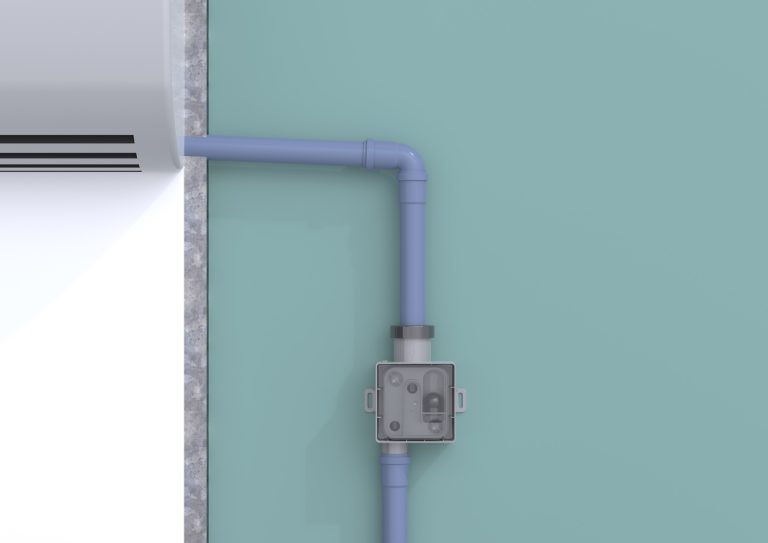
In the best case scenario, rigid drainage pipes with a sufficient internal diameter (HAT pipe DN32) and a continuous slope in the direction of flow are installed to drain the condensate. If a flexible condensate hose is used, it is essential to ensure that the slope is also continuous here. (Please follow our installation instructions when installing the HL138N condensate siphon).

Correct installation of an HL138 with HAT pipe and continuous slope

How can I subsequently solve the problem of water leaking from the air conditioning unit as a result of double siphoning?

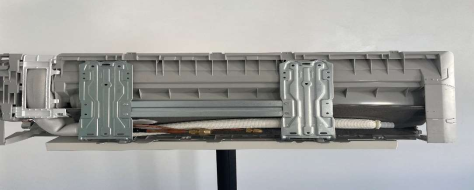
A professional solution is retrospectively only possible with great effort. The water seal in front of the appliance siphon must be removed and a continuous slope created from the air conditioning unit to the appliance siphon. The upstream siphon can also be located inside the appliance. In this case, the problem can be solved with little effort. It is usually sufficient to install the appliance slightly higher in order to create a condensate line with a continuous slope.

An indoor unit in which the condensate hose is already hanging down inside the unit

Conclusion

The dripping of an air conditioning system can be attributed to various causes, but the most common is double siphoning. This is caused by incorrect installation of the condensate hose and can lead to considerable water damage. To avoid the problem, it is important to ensure a continuous gradient pipe or use rigid drain pipes when installing the air conditioning system.

If water is already leaking, the subsequent solution of double siphoning requires more effort. In such cases, expert measures should be taken to create a continuous gradient pipe and drain the condensate properly.

If you are experiencing problems with a dripping air conditioner or would like more information on draining it and avoiding double siphoning, visit our website at www.hl.at. There you will find useful tips, solutions and products to operate your air conditioner optimally (e.g. the HL138N), or contact our sales representatives or application engineers. auch gerne unser Kontaktformular ausfüllen, um direkt mit unseren Experten in Verbindung zu treten. Alternativ können Sie uns auch telefonisch unter der Nummer +43 (0)2235 87 748 erreichen. Wir helfen Ihnen gerne weiter, damit Sie ein angenehmes und problemfreies Klimatisierungserlebnis genießen können.

Leave a Reply

Your email address will not be published. Required fields are marked *