



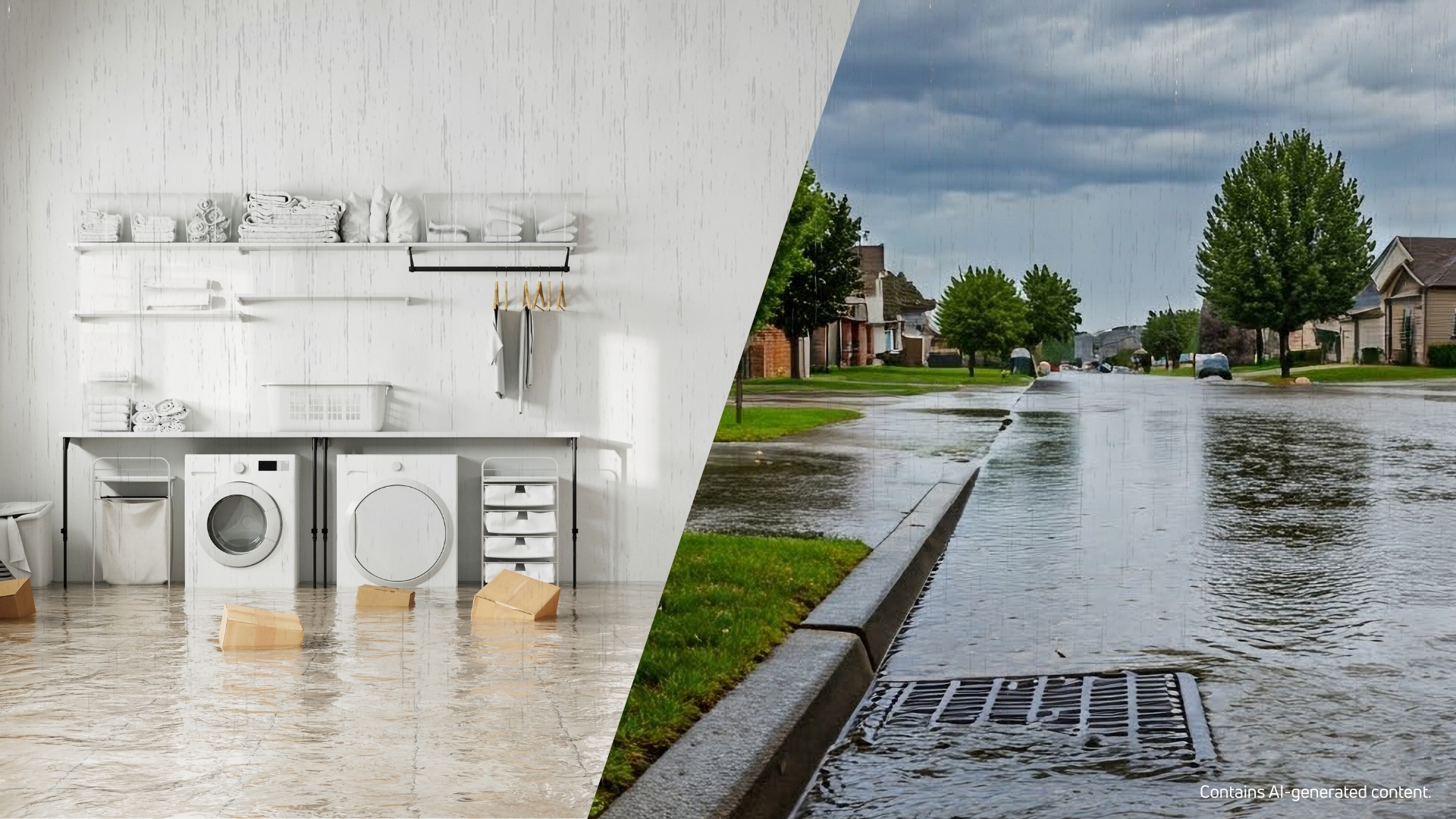
Like many regions of Europe, Austria is experiencing increasingly extreme weather. Long periods of drought and heat are more and more often followed by intense heavy rainfall events in which enormous amounts of rainwater fall within a very short time. The previously dried-out soil is often able to absorb only a limited amount of this water, so it runs off over the surface and accumulates quickly. At the same time, sealed surfaces in built-up areas further hinder natural infiltration.
The consequences are local flooding, overloaded drainage systems and increasing damage to buildings and infrastructure. Recent studies show that the intensity and frequency of heavy rainfall events in Austria have already increased. One-hour heavy rainfall events are defined as rainfall in which exceptionally large amounts of rainwater occur within one hour. The intensity of these one-hour heavy rainfall events has risen by around 15 % over the past four decades (GeoSphere Austria, 2025). Experts expect this trend to continue. This makes it all the more important to adapt buildings and drainage systems to the changing climatic conditions and to take suitable protective measures at an early stage.
Heavy rainfall: an uninvited guest in the building
Heavy rainfall can cause considerable damage to buildings. Basements and ground floors are particularly at risk, as they are either in direct contact with the ground or have numerous openings to the outside of the building. The causes of water ingress can vary widely and should be taken into account as early as the building design stage:
- Rising groundwater:
After intense rain, the groundwater level can rise and act on building components in contact with the ground. Basements and foundations must therefore be waterproofed professionally, appropriate to the water exposure and in accordance with ÖNORM B 3692. (For more information, see the article The critical 1% that causes 90% of water damage.) - Penetrating rainwater:
Surface water can enter the building through basement windows, light wells, external basement stairs or doors. Suitable site grading and adequately dimensioned drainage help to prevent this. - Flooding:
During floods, bodies of water can burst their banks and flood properties. As protecting the building itself is often only possible to a limited extent, the flood risk should be taken into account as early as site selection and planning. - Backflow:
During heavy rainfall, the public sewer network can become overloaded, causing backflow. Without suitable backflow protection, water can enter the building via lower-lying drainage points. This risk is a frequently underestimated cause of water damage in basements.
What is backflow and how does it occur?
Sewer systems are dimensioned to safely discharge the volumes of water that occur during normal operation. However, enlarging sewer dimensions without limit would not make sense economically or technically, as exceptional rainfall events with very large volumes of water would also have to be taken into account. During intense heavy rainfall events, the capacity limit of the sewer network can therefore be reached. The water can no longer drain away quickly enough, rises in the sewer and spreads through the drainage system. As a result, it can be pushed back towards the building against the normal direction of flow and escape from connected drainage points inside the building. This process is known as backflow.
Backflow mainly affects drainage points such as floor drains, washing machine connections or other drainage installations in basements and lower-lying areas of the building. The decisive factor here is the backflow level. If drainage points are located below the backflow level, there is a risk that water from the sewer will enter the building through them.
The backflow level is the maximum height to which the water in the sewer can rise. It is therefore the limit up to which a building is at risk from backflowing water if no suitable protective measures are in place. According to ÖNORM B 2501, the relevant backflow level is generally 15 cm above the level of the nearest manhole or gully grate when viewed against the direction of flow. In buildings on sloping sites, individual parts of the building can lie considerably lower than the public sewer connection. In extreme cases, this means that not only basements but also the ground floor or even upper storeys can lie below the relevant backflow level. If the backflow level cannot be clearly identified due to local conditions, it must be determined professionally, taking into account the terrain, dips in the road, underpasses and potential flood zones.
However, whether a building can actually be affected by backflow does not depend solely on the position of the drainage point. The risk of backflow depends on various factors:
- Type of sewer network: In a combined sewer system, rainwater and wastewater are discharged together through one sewer, which means that large volumes of water can accumulate within a short time during heavy rainfall and promote backflow.
- Pumping stations: Restrictions or faults at pumping stations can impair the flow and thereby increase the risk of backflow.
- Blockages and deposits: Deposits, constrictions or other obstructions in the sewer network can impede the flow and cause the wastewater to back up.
- The building’s drainage system: A drainage system that has not been properly designed and installed can expose a building to an increased risk of backflow.
Safe even below the backflow level
There is no universal answer to the question of how to protect a building against backflow. The appropriate measure depends, among other things, on the position of the sanitary appliances, the slope to the sewer, the type of wastewater produced and the use of the rooms concerned.
According to ÖNORM B 2501, wastewater from above the relevant backflow level must be discharged into the sewer system by gravity. Drainage points below this level must be protected against backflow. Depending on the local and structural conditions, suitable backflow valves or wastewater lifting systems can be used.
In principle, the ÖNORM specifies a wastewater lifting system. However, under the following conditions it can be replaced by a backflow valve, which is the more economical solution:
- There is sufficient slope to the public sewer.
- The backflow valve is suitable for the intended purpose and the type of wastewater.
- The rooms concerned are only used for subordinate purposes.
- The group of users is limited to a private household.
- At least one WC above the backflow level remains available.
- The protected drainage point can be left unused during a backflow event.
Special requirements also apply to rainwater from surfaces below the backflow level. If the water cannot infiltrate on site, a wastewater lifting system or backflow lifting system must generally be provided. Surfaces smaller than 10 m² can be drained via a suitable backflow valve. In this case, there must be sufficient slope to the sewer as well as structural protective measures that prevent water from entering lower-lying rooms.
Backflow protection with lifting systems
A wastewater lifting system collects the wastewater produced below the backflow level and pumps it into the sewer system via a discharge pipe. The discharge pipe is routed as a backflow loop above the relevant backflow level. According to ÖNORM B 2501, the invert of the backflow loop must be at least 10 cm above this level.
A lifting system is required in particular if there is insufficient slope to the sewer or if the conditions for using a backflow valve are not met. Provided it is adequately dimensioned and ready for operation, the connected sanitary appliances can continue to be used even during a backflow event.
Installing a lifting system requires sufficient space for its tank, pump, control unit and discharge pipe, as well as an electrical power connection. For systems with increased requirements for operational reliability, an alarm device, a twin lifting system or an emergency power supply may also be necessary. As the system’s function depends on mechanical and electrical components, regular inspections and maintenance are required. In addition to high purchase costs, lifting systems and backflow lifting systems therefore also incur running costs for energy, maintenance and possible wear parts.
Backflow protection with backflow valves
A backflow valve is installed directly in a drainage pipe or a drain. In normal operation, the wastewater flows unhindered to the sewer. In the event of backflow, the closure shuts and thereby prevents sewer water from entering the building. Depending on the design, backflow valves operate mechanically or are electrically controlled. Mechanical versions close automatically under the pressure of the backflowing wastewater and do not require a power supply. Electrically controlled models close by means of a motor-driven closure and, depending on their features, can also provide a visual and acoustic alarm and monitoring of the operating status. With electrically controlled backflow valves, the operating closure remains open in normal operation, which keeps the pipe cross-section largely clear and promotes unobstructed flow.
ÖNORM EN 13564 distinguishes between the following types:
- Type 0: Backflow valve with one automatic closure
- Type 1: Backflow valve with one automatic closure and one emergency closure
- Type 2: Backflow valve with two automatic closures and one emergency closure
- Type 3: Backflow valve with one externally powered automatic closure and one emergency closure
- Type 4: Backflow valve integrated into a drain assembly or floor drain, with one automatic closure and one emergency closure
- Type 5: Backflow valve integrated into a drain assembly or floor drain, with two automatic closures and one emergency closure
In Austria, the currently applicable ÖNORM B 2501 permits types 2 and 3 for wastewater containing faecal matter. Provided that all conditions of use (see above) are met, an electric drive is therefore no longer mandatory in such cases. Mechanical backflow valves operate without a power supply and allow easier inspection and cleaning. Furthermore, versions with stainless steel flaps protect against rats and other rodents entering from the sewer network. The choice of a suitable type depends on the type of wastewater, the installation situation and the use of the building.
Table 1: Types of backflow valves according to ÖNORM EN 13564-1
Type according to | Suitable wastewater | Typical applications | Matching HL product |
Type 0 | Faecal-free wastewater and rainwater below the backflow level | Drainage points below the backflow level without WC connection | |
Type 1 | Faecal-free wastewater and rainwater below the backflow level | Drainage points below the backflow level without WC connection, where a manual shut-off option is also required | |
Type 2 | Faecal-free wastewater, wastewater containing faecal matter and rainwater below the backflow level | Drainage points below the backflow level with WC connection | |
Type 3 | Faecal-free wastewater, wastewater containing faecal matter and rainwater below the backflow level | Drainage points below the backflow level with WC connection, where an externally powered closure is desired or required | |
Type 4 | Faecal-free wastewater and rainwater below the backflow level | Floor drains below the backflow level without WC connection | – |
Type 5 | Faecal-free wastewater and rainwater below the backflow level | Floor drains below the backflow level without WC connection |
Only drainage points below the relevant backflow level may be drained via a backflow valve. Wastewater produced above this level must be discharged into the sewer system downstream of the backflow valve. Otherwise, while the operating closure is shut during a backflow event, this water could back up within the building drainage and cause self-flooding. The backflow valve must remain permanently accessible for inspection, cleaning and maintenance.
For larger or commercially used buildings, a lifting system is generally required. In private residential buildings, a suitable backflow valve can be an economical and reliable solution, provided the requirements of the standards are met. HL’s technical team will be happy to help with selection and planning.
Retrofitting backflow protection in existing buildings
In existing buildings, the existing pipe layout and limited space often make it difficult to retrofit standard-compliant backflow protection. The first step is a detailed survey of the existing situation, taking into account the relevant backflow level, drainage points at risk, the existing slope to the sewer, the type of wastewater and the use of the rooms concerned.
According to ÖNORM B 2501, wastewater produced above the backflow level must still be discharged into the sewer system by gravity. Where possible, drainage areas above and below the backflow level must be routed separately. Drainage points below this level must generally be drained via a wastewater lifting system with a backflow loop or via a backflow valve.
However, if separating the drainage areas in an existing building is not economically or physically feasible, the ÖNORM permits, under certain conditions, a combined solution consisting of a type 3 backflow valve and a lifting system.
If neither of these standard-compliant solutions can be implemented, a space-saving and economical special solution with a backflow valve can be considered on a case-by-case basis. However, this entails the risk of self-flooding described above. A professional assessment, for example by HL’s technical team, is therefore essential.
Keeping backflow protection working over the long term
Even backflow protection that has been selected and installed in compliance with the standards can only work reliably if all components are regularly inspected, cleaned and maintained. Deposits, foreign objects and damage can prevent a backflow valve from closing completely. In lifting systems, failures can be caused by faults in the pump, level control, non-return valve or alarm device.
For backflow valves, ÖNORM EN 13564-1 recommends an on-site inspection and function test twice a year. For types 0, 1, 2, 4 and 5, this may be carried out by competent persons. Type 3 backflow valves must be inspected by qualified specialists.
For wastewater lifting systems, ÖNORM EN 12056-4 states that the operator should check operability monthly by observing at least two switching cycles. Professional maintenance of a lifting system is intended at least every three months for commercial installations, every six months in apartment buildings and once a year in single-family houses. In addition, the system must be flushed through with water every two years.
You can find an authorised HL service partner for backflow valves near you here. For technical questions and help finding a suitable solution, the HL support team is at your service.
Backflow prevention starts at the planning stage
Backflow in the public sewer cannot be completely prevented. However, forward-looking building drainage can significantly reduce the load on the drainage system and the risk of damage.
One important measure is the separate drainage of wastewater and rainwater. According to ÖNORM B 2501, both types of water must be routed in separate pipes inside the building in new builds. Even where the public sewer is a combined sewer, this separation should be maintained as far as the street sewer wherever possible. This keeps the building drainage hydraulically straightforward and allows the rainwater to be infiltrated, retained or used in a targeted way.
Green roofs and retention roofs store part of the rainwater and release it with a delay. This reduces peak runoff and relieves the sewer network during heavy rainfall. Infiltration systems, retention tanks or cisterns can be used in addition. ÖNORM B 2501 recommends infiltration on the property, provided the soil and local conditions are suitable. However, green roofs and other retention measures do not replace any required backflow protection.
Structural protective measures are just as important. The terrain and all paved surfaces should be designed so that surface water is directed away from the building. Basement windows, light wells, external basement stairs and garage entrances below the relevant backflow level can be protected by raised upstands, thresholds or suitable waterproofing. Rainwater from surfaces below this level must not be discharged by gravity into the sewer at risk of backflow without protection.
Effective backflow prevention therefore results from the interplay of rainwater retention, separate drainage pipes, structural flood protection and standard-compliant backflow protection.
Conclusion: planning, technology and maintenance working together
Backflow in the public sewer cannot be completely prevented, but in many cases damage to the building can. The key is to identify drainage points and building areas at risk at an early stage and to adapt the drainage to the backflow level, the use of the building and the local conditions.
Whether lifting system or backflow valve, the appropriate solution must comply with the requirements of the applicable ÖNORM standards and be tailored to the specific application. Professional planning, correct installation and regular inspection and maintenance are just as important as structural precautions and well-thought-out rainwater management.
A great deal of avoidable backflow damage is caused by planning errors or unsuitable protective measures. Backflow protection should therefore be considered from the outset together with specialist planners and installers.
References
- Austrian Standards International: ÖNORM B 2501:2025-02-01 – Drainage systems for buildings and sites – Design, construction and testing – Additional specifications to ÖNORM EN 12056 (all parts). Vienna: Austrian Standards International.
- Austrian Standards International: ÖNORM EN 12056-4:2000-12-01 – Gravity drainage systems inside buildings – Part 4: Wastewater lifting systems – Layout and calculation. Vienna: Austrian Standards International.
- Austrian Standards International: ÖNORM EN 13564-1:2002-10-01 – Anti-flooding devices for buildings – Part 1: Requirements. Vienna: Austrian Standards International.
- GeoSphere Austria (2025): Starkregen hat deutlich zugenommen [Heavy rainfall has increased significantly]. Published on 12 March 2025. geosphere.at/de/aktuelles/news/starkregen-hat-deutlich-zugenommen (accessed on 6 August 2026).
Note: The technical information reflects the status of the standards as of August 2026. The current standards and the local requirements of the responsible sewer network operator must always be observed during planning and installation. This article provides technical guidance but does not replace project-specific professional planning.